
The White Ensign of the Kenya Navy evolved from the White Ensign of the Royal Navy. After the crusades, the Red Cross of Saint George was accepted as the Emblem of the Royal Navy. However, the background colour varied till about the 17 Century when three colours - white, red and blue - were adopted for the Ensign and represented different sections of the fleet.
The White Admiral commanded the Squadron in the Van and had a White Ensign; the Red Admiral commanded the Middle with a Red Ensign and the Rear became the Blue Admiral's position with a Blue Ensign. The order of seniority was red, blue and white.
But during the Battle of Trafalgar, Admiral Nelson ordered the entire British Fleet to hoist the White Ensign to avert any confusion. It was only in 1864 that the Royal Navy adopted the White Ensign as its colours while the Red Ensign became the colours of the Merchant Navy. The priviledge of wearing a Blue Ensign was guaranteed to Naval Auxilliaries as well as Merchant Vessels having a percentage of ex-naval personnel in their crew or those on charter to the Royal Navy.
This tradition continues even today. On attaining independence, the White Ensign of the Kenya Navy was modified to suit the aspirations of the young nation of Kenya.
Traditionally, the Navy has always paid great respect to the flag, and many of the Service's most sacred ceremonies are centered on the hoisting and lowering of colours. Starting with the familiar colours ceremony that all units observe every morning and evening, these rituals serve to inculcate and strengthen a sense of patriotism in all the participants.The importance of these ceremonies must never be underestimated. Men and women have died for their flag; it is a symbol of the Navy and all that it represents. THE KENYA NAVY OFFICERS
In the Kenya Navy the word Officer encompasses all personnel belonging to the Officer Cadre, a status which entitles them to command men/women and singles them out as foremost trusted representatives of the state. Traditionally officers from the Executive Branch (Seamen/women) are privileged to command ships.
An officer of the Kenya Navy is required to live by strong and rigid codes which govern their conduct at all times. His/her integrity should be above doubt and is not expected to accept any favours, services and unusual entertainment in the performance of his/her duties.
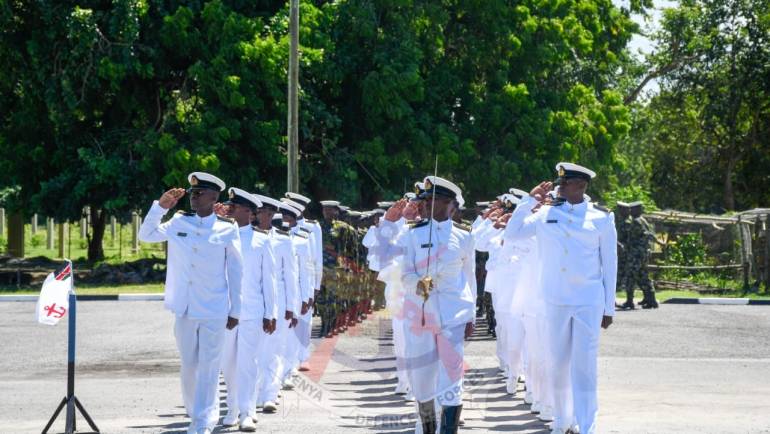
The life of a Navy Officer actually begins on board a training ship. After leaving the Armed Forces Training College (AFTC) and integration into the Naval Training School (NTS), all become equal in their status. Unlike the Kenya Army or the Air Force, Basic Training brings Naval Cadets shoulder to shoulder with the men and women they are going to command in future. The intention is to bring up officers and gentlemen, who should be, able seamen/women, adept at managing a ship or a battle at sea, possess discretion and courage and equate conveniently with men/women they lead.
Therefore a Navy Officer has " …a liberal education, refined manners punctilious courtesy and the nicest sense of personal honour …"
MIDSHIPMAN
From a historical perspective, Midshipmen were originally men/boys stationed amidships in the days of sail to carry messages, bring up ammunition, or relay messages from the poop to the gun decks. One of the best known officer midshipman was Hortio Nelson, who enrolled at the tender age of twelve-and-a half years on board HMS Raisonnable in 1771.
It was only in 1815 that Midshipman became a rank in the British Navy. But their duties remained varied. A story is told that due to a mix-up in salute between a British Captain and an American Rear Admiral, the senior ordered his midshipman to go on board the British ship and "make the British Captain feel sorry for his mistakes". Small wonder that it took courage, quick wit, and above all a youthful spirit to perform duties of a midshipman effectively. In fact, it has now become a common belief that the most thrilling and amusing events in an officer's career occur during his days as a midshipman.
The life of a Midshipman in the Kenya Navy today is very different from the old days. On his way to become a fully-fledged Officer of the Navy, he is expected to develop his professional knowledge during training while exercising his wits whenever an opportunity arises. Much of his lessons should come from observations and evolutions in considerable detail and at least, he/she has the liberty to make mistakes without having to pay for them.
THE KENYA NAVY OFFICERS' BADGES
SECOND LIEUTENANT (MIDSHIPMAN)
As the name suggests, 2nd Lieutenant are Assistants to Lieutenants and are expected to carry out all the duties of Lieutenant in his absence. Kenya Navy Officers start their Commissioning as Acting Second Lieutenants, a rank in which they receive a Commission from the Head of State by virtue of which they get recognized as Gazetted Officers. |